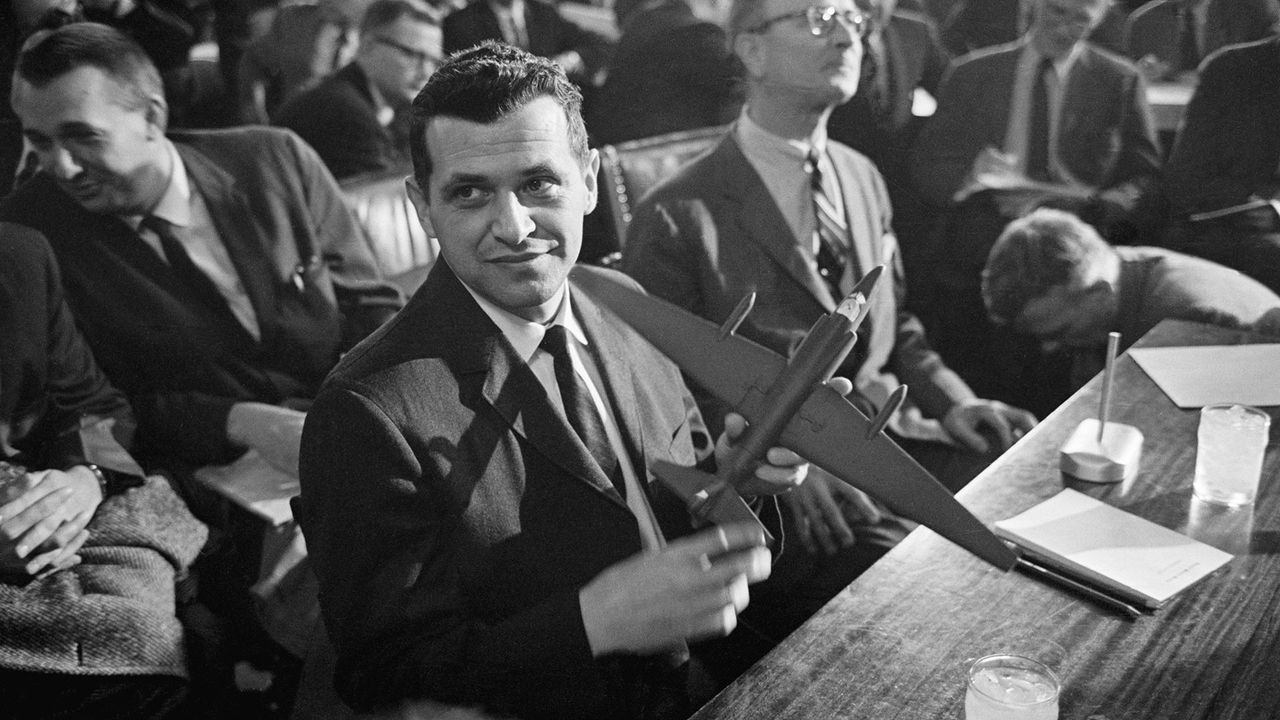

During the heated Cold War years, an undercover mission within Soviet airspace evolved into a global crisis, capturing worldwide attention and heightening the rivalry between dominant nations. On May 1, 1960, an American U-2 spy plane, with pilot Francis Gary Powers at the helm, set off on what was intended to be a standard intelligence mission flying over the Ural Mountains. The sortie, however, deviated dramatically from routine plans. It concluded in a catastrophic crash, an occurrence that would unveil the espionage efforts of the United States and result in a major diplomatic conflict. The episode served as a stark reminder of the intense stakes at play in the covert battle for dominance between the East and West.
The U-2, known as the “Dragon Lady,” was an extraordinary piece of technology for its time, designed to fly at altitudes exceeding 70,000 feet, far above the reach of conventional Soviet air defenses. Its purpose was to photograph military installations, missile sites, and other strategic targets deep within the Soviet Union. These missions, authorized at the highest levels of government, were a critical component of US intelligence efforts, providing a window into Soviet military capabilities that would otherwise be impossible to obtain. The plane’s high-altitude performance was its primary defense, making it virtually immune to interception by Soviet fighter jets or surface-to-air missiles of the era.
The task assigned to Powers, called “Operation Overflight,” was just one of numerous covert missions. He launched from a United States airfield in Peshawar, Pakistan, aiming to touch down in Bodø, Norway. His route included a journey over the wide territory of the Soviet Union, enabling him to gather important photographs of crucial locations, such as a location thought to be an intercontinental ballistic missile testing area. Everything proceeded smoothly with the mission until he approached the town of Sverdlovsk, which is presently Yekaterinburg. At this point, the previously unstoppable U-2 faced its downfall.
The Soviet Union’s persistence in developing countermeasures against the U-2 was relentless. For years, their air force had attempted and failed to intercept the high-flying planes. However, on this fateful day, they had a new weapon: the S-75 Dvina, a sophisticated surface-to-air missile system, code-named “SA-2 Guideline” by NATO. When Powers’s U-2 was detected on radar, Soviet commanders gave the order to fire. What followed was a complex chain of events, where multiple missiles were launched, one of which detonated near the U-2, causing it to break apart in the sky.
Powers was able to endure the blast and escape from the damaged plane. He floated down into Soviet land using a parachute, in a tense and dangerous descent that would determine his destiny. Unknown to the American authorities, who believed the U-2 would destroy itself if it crashed, Powers had survived and was held by the Soviets. The first cover story from the US, stating that the U-2 was a meteorological research aircraft that had accidentally gone off its path, was soon discredited when the Soviets showcased a disordered Powers and parts of the debris to the global press.
The capture of the pilot and the remains of the advanced spy plane was a major propaganda victory for the Soviet Union. Soviet Premier Nikita Khrushchev used the incident to humiliate the United States and highlight its aggressive and deceptive policies. The timing of the event, just weeks before a scheduled summit in Paris between US President Dwight D. Eisenhower and Khrushchev, was particularly damaging. The summit, intended to ease Cold War tensions, collapsed as a result of the U-2 scandal. Khrushchev’s public demands for an apology from Eisenhower went unmet, and the summit ended in a bitter stalemate, leading to a new period of heightened hostility.
The U-2 event significantly affected global diplomacy. It not only terminated the short-lived détente between the US and the Soviet Union but also altered espionage practices. The United States had to reevaluate its methods of intelligence gathering, which resulted in increased dependence on satellite surveillance. Powers, on the other hand, turned into a piece in a high-tension international chess game. He underwent a widely publicized judicial process, where he was convicted of spying and given a three-year prison term coupled with seven years of forced labor. Nonetheless, his hardships did not extend for the entire duration of the sentence.
In a surprising development, Powers was set free in 1962 due to a swap of captives. He was exchanged for Soviet intelligence agent Rudolf Abel at the Glienicke Bridge, famously known as the “Bridge of Spies,” a site that has become associated with Cold War secrets. The swap was an uncommon instance of collaboration in an otherwise hostile interaction, offering some resolution to the U-2 event. Powers’s arrival back in the United States was greeted with both doubt and respect. He underwent heavy examination by the CIA and the general public, with some questioning his behavior and allegiance.
Ultimately, a Senate investigation cleared Powers of any wrongdoing, concluding that he had acted properly under extreme circumstances. The U-2 incident and the subsequent events served as a stark lesson in the realities of Cold War espionage. It revealed the lengths to which both superpowers would go to gain a strategic advantage and the inherent risks of such covert operations. The incident also underscored the importance of deniability in intelligence work and the devastating consequences of its failure.
The impact of the U-2 affair lingers, not only in historical records but also in popular culture, where it continues to embody the secretive essence of the Cold War. It marks a time when the covert conflict between countries was revealed, shedding light on the deceit and peril characterizing that period. The picture of the crashing, damaged aircraft endures as a strong emblem of a failed mission and the personal cost for those engaged in the secret war.
The story of the U-2 incident is a testament to the complex web of diplomacy, technology, and human courage that characterized the Cold War. It reminds us that even in a conflict waged in the shadows, the smallest misstep can have monumental consequences. The incident stands as a crucial turning point, a moment when the world held its breath as two global giants confronted each other, not with tanks and armies, but with secrets and lies.